
How to Hang Art Without Damaging Walls
Table of Contents
- What You'll Need Before You Start
- Best Adhesive Strips for Posters and Lightweight Art
- How to Hang Heavy Pictures Without Nails
- How to Hang Art Without Damaging Walls: A Step-by-Step Method
- Hanging Art on Different Wall Types
- Damage-Free Wall Decor Ideas for Any Room
- Getting the Height and Spacing Right
- Frequently Asked Questions
Last Updated: 2 September 2026
Hanging art transforms a house into a home, but the fear of drilling into walls, cracking plaster, or losing a rental deposit stops many people before they even start. According to 98 Types Camden's rental market research, around 35% of households rent, and most tenancy agreements prohibit wall damage outright. That makes knowing how to hang art without damaging walls not just a stylistic preference, it is a practical necessity for a third of the population. At Pitch Black Print, we hear this concern constantly from customers who want to display their travel posters but are not sure how to do it safely.
The good news: damage-free hanging has come a long way. Modern adhesive strips, picture rail systems, and mechanical anchors mean you can hang everything from a lightweight poster to a substantial framed print without touching a drill. Below, we cover every method worth knowing, matched to wall type and artwork weight, so you can choose the right approach the first time.
What You'll Need Before You Start
Before you commit to any method, gather these basics: a soft tape measure, a spirit level, a pencil, a microfibre cloth and isopropyl alcohol for cleaning wall surfaces, and the hanging hardware appropriate to your chosen method.
Knowing your wall type matters enormously. Tap the wall with your knuckle: a hollow sound indicates plasterboard or drywall, while a solid thud suggests brick or dense plaster. First4Frames Gallery's guide to wall types and fixings notes that drywall accounts for approximately 80% of interior walls in modern homes, so most people will be working with it.
Weigh your artwork before you do anything else. A small unframed poster weighs almost nothing; a large framed print can easily exceed 3 kg. That single number determines which method is safe to use.
| Method | Max Weight | Best For | Wall Type |
|---|---|---|---|
| Adhesive strips | Up to 7.2 kg per pair | Posters, lightweight frames | Drywall, smooth plaster |
| Picture hooks (no-nail) | Up to 2 kg | Small prints, cards | Most smooth surfaces |
| Drywall claws | Up to 11 kg | Medium-heavy frames | Plasterboard only |
| Picture rail + hooks | Unlimited (rail dependent) | Any size | Walls with existing rail |
| Traditional wall plug | Unlimited | Heavy frames | Brick, solid plaster |
Best Adhesive Strips for Posters and Lightweight Art
Adhesive hanging strips are the go-to solution for renters, redecorators, and anyone who wants a reversible result. The best adhesive strips combine a strong initial bond with a clean-release mechanism, usually a stretchable tab you pull straight down to disengage the adhesive without tearing paint.
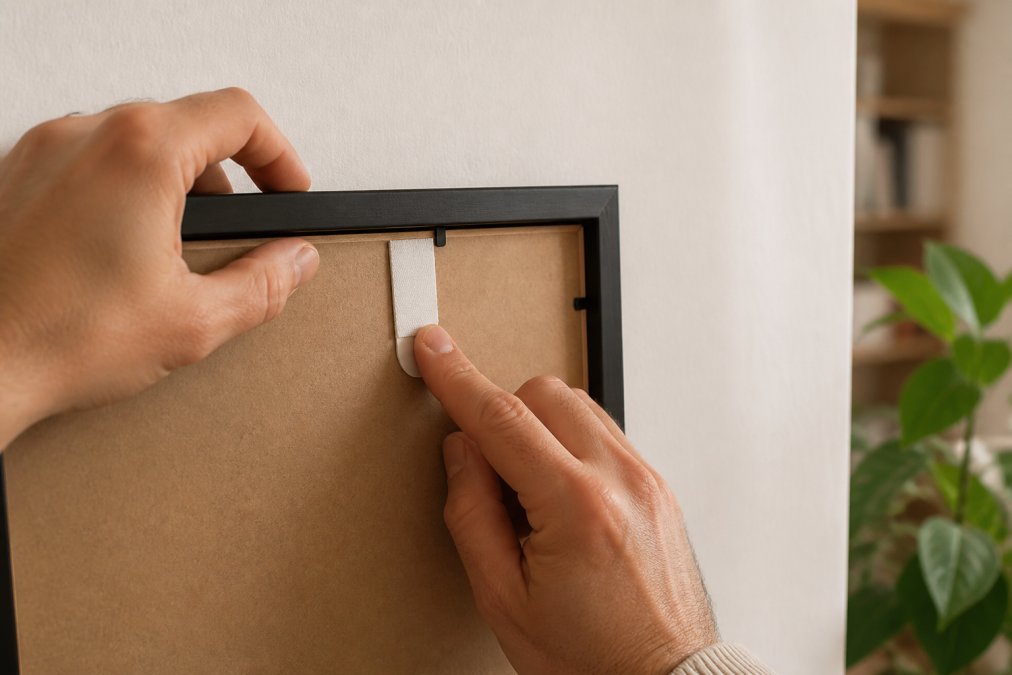
Command-branded strips are the most widely tested option on the market. According to testing by Proper DIY's Command strip load test on YouTube, Command Picture Hangers rated for 3.6 kg successfully held 9 kg without failing, nearly three times their stated capacity, and removed cleanly without leaving a mark when instructions were followed precisely. A pair of their larger strips is rated to support up to 7.2 kg, making them suitable for most standard-sized framed prints.
How to Apply Adhesive Strips Correctly
Most adhesive strip failures trace back to applying to a dusty surface, skipping the cure time, or pulling the strip outwards instead of straight down on removal.
Follow these steps for a reliable result:
- Clean the wall with isopropyl alcohol and allow it to dry completely.
- Clean the back of the frame in the same way, particularly at the corners where the strips will sit.
- Press the strips together (interlocking sides facing) before mounting. Hold for 30 seconds.
- Press the frame against the wall for at least 30 seconds, applying firm, even pressure.
- Wait one hour before hanging anything on the frame. Overnight is better for heavier pieces.
- To remove, pull the tab straight down slowly and steadily, never outwards.
When Adhesive Strips Are Not the Right Choice
Adhesive strips have real limitations. Avoid them in these situations:
- The wall surface is textured, rough, or wallpapered (adhesion is unreliable)
- The frame weighs more than the strip's stated maximum
- The room experiences significant humidity fluctuations (bathrooms, kitchens)
- The wall has been freshly painted within the last four weeks
For anything over 3 kg on a smooth surface, use multiple pairs and test with a gentle tug before walking away.
How to Hang Heavy Pictures Without Nails
Heavier artwork demands a more mechanical solution. Learning how to hang heavy pictures without nails no longer means choosing between a drill and a bare wall.
Drywall Claws and Hook Anchors
Drywall claws work by gripping the back face of the plasterboard as you drive a small pin through the surface at an angle. They leave only a tiny entry hole, comparable in size to a drawing pin, and most landlords would not class this as damage.
A single drywall claw typically supports 10-11 kg, which covers the majority of framed prints. For very large or heavy pieces, use two claws set 10-15 cm apart, which distributes the load and prevents the hook from tilting.
Installation takes under two minutes: mark your position with a pencil, position the hook, and press the pin through the plasterboard at the recommended angle using your thumb or a small hammer.
Picture Rail Systems
Picture rails are a feature of many older properties, a wooden or metal moulding running near the ceiling from which hooks and wires suspend artwork at any height. If your walls already have a picture rail, this is the most damage-free method available: nothing touches the wall below the rail at all.
The system is simple: a metal hook sits over the rail, and a length of picture wire drops down to the frame. Adjusting height is a matter of moving the hook or changing the wire length. If your property does not have a picture rail, adhesive-mounted rail systems are available that fix to the wall surface without drilling.
How to Hang Art Without Damaging Walls: A Step-by-Step Method
This method works for most framed prints on drywall or smooth plaster using adhesive strips or a drywall claw.
What you'll need: spirit level, tape measure, pencil, microfibre cloth, isopropyl alcohol, adhesive strips or drywall claw hooks.
Total time: approximately 15 minutes.
- Measure and mark the centre point of where you want the artwork. The standard museum hang places the centre of the artwork at 152 cm from the floor, a height that suits most rooms and viewers.
- Clean the wall at the fixing points using isopropyl alcohol. Allow to dry.
- Attach strips or position the hook according to the method you have chosen. For adhesive strips, press firmly for 30 seconds per strip.
- Check level using a spirit level before the adhesive fully cures. Adjust immediately if needed.
- Wait the recommended cure time (one hour minimum for adhesive strips) before hanging.
- Hang the artwork and step back to assess the position.
As interior design blogger Janet Clarke advises:
"Even if you're hanging a lighter piece, it is worth using a stud finder to mark where the studs are so you won't have to worry about this in the future. Just make a mark with a pencil where the studs are at the top of a wall where it meets the ceiling." -- Janet Clarke, Interior Designing Blogger, Systematic Art (2020)
Hanging Art on Different Wall Types
The method that works perfectly on plasterboard can fail completely on brick. Wall type is the variable most guides gloss over, and it is the one that matters most for a secure, damage-free result.
Plasterboard and Drywall
Plasterboard is the most forgiving surface for damage-free hanging. Adhesive strips bond reliably to its smooth painted surface, and drywall claws grip the board's inner face with minimal surface disruption. For anything under 7 kg, adhesive strips are the simplest choice. For 7-11 kg, a pair of drywall claws is more reliable.
One genuine risk with plasterboard: hanging too close to the edge of a board or near a poorly taped seam. Tap around the area first; a change in sound indicates a seam or void. Avoid fixing within 5 cm of any seam.
Solid Plaster and Brick
Solid plaster over brick is the wall type found in most pre-1960s properties. It is harder, denser, and less forgiving of adhesive solutions. Command-style strips can work on smooth painted plaster, but surface irregularities reduce adhesion significantly.
For heavier pieces on solid walls, a traditional picture hook with a masonry nail is the most reliable no-drill option. If you are willing to use a drill, a wall plug and screw provides the most secure fixing for any weight.
Wallpapered Walls
Wallpapered walls are the most challenging surface for damage-free hanging. Adhesive strips bond to the paper rather than the wall, which means the strip can pull the wallpaper away from the surface when removed.
For wallpapered walls, picture rails are the safest option. If no rail exists, use the lightest possible fixing method and test adhesion in an inconspicuous area first. Avoid adhesive strips on wallpaper for anything heavier than a single unframed sheet.
Damage-Free Wall Decor Ideas for Any Room
Damage-free wall decor is not just a practical workaround, it has become a deliberate design choice. The principle of reversible mounting means you can refresh a room seasonally, experiment with layouts before committing, and protect your walls for resale or rental handback.
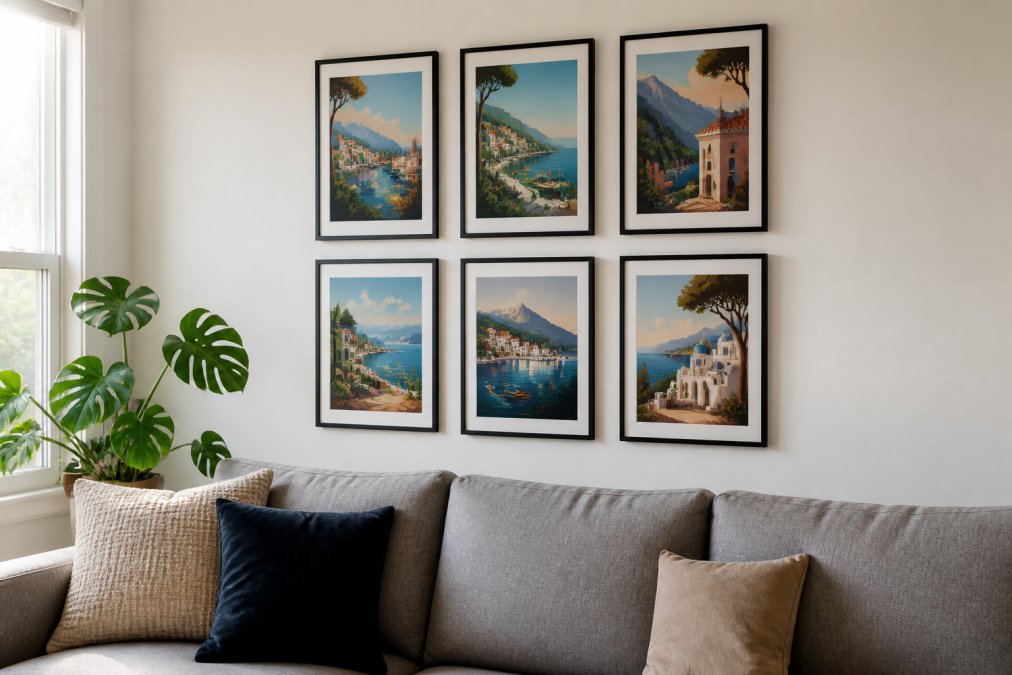
A few ideas worth trying in any room:
Gallery wall with adhesive strips. Group three to five prints of varying sizes asymmetrically. According to DecorArts' gallery wall spacing guide, each piece should have at least a few centimetres of space around it so individual artworks read clearly while contributing to the overall composition.
Leaning prints. Large format prints leaned against a wall on a shelf or mantelpiece require no fixing at all. This works particularly well for oversized pieces that would demand significant fixings if hung.
Clipboards and washi tape. For paper prints and posters, a clipboard or strip of washi tape at the top edge is entirely reversible and suits more casual, eclectic interiors.
Poster frames with command strips. A lightweight poster frame combined with adhesive strips is the most versatile combination for renters. Pitch Black Print offers prints in a choice of black, white, or oak frames, all of which are lightweight enough to pair with adhesive strip hanging for most standard wall types.
Getting the Height and Spacing Right
Most people hang their art too high. The eye naturally seeks the centre of an image at roughly its own level, not above it.
The standard used by museums and galleries places the centre of the artwork at 152 cm from the floor Little House in London's art hanging height guide. This works in most rooms with standard ceiling heights. For rooms with lower ceilings, drop the centre point to 140-145 cm.
When hanging art above furniture, the bottom edge of the piece should sit approximately 15-30 cm above the top of the sofa, console, or sideboard beneath it. This visually connects the art to the furniture rather than floating it in empty space.
For gallery walls, plan the arrangement on the floor first. Cut paper templates to the size of each frame and arrange them on the floor until you are satisfied. Then tape the templates to the wall and adjust before making any fixings. Aim for 5-8 cm between frames: closer than 5 cm and the pieces compete visually; further than 10 cm and the arrangement loses cohesion.
Hanging art confidently without damaging your walls comes down to matching the right method to your wall type, your artwork's weight, and your situation as a homeowner or renter. For anyone building a gallery wall or displaying a statement piece, Pitch Black Print's travel poster collection offers prints available poster-only or professionally framed in black, white, or oak, making it straightforward to choose a format that suits your chosen hanging method. With free worldwide shipping and a 14-day return policy, there is no risk in getting started. Browse the collection at Pitch Black Print and find the piece that belongs on your wall.
Frequently Asked Questions
What is the best way to hang heavy art without nails?
For heavier pieces, drywall claws and self-drilling picture hooks are the most reliable nail-free options. They grip plasterboard firmly using a twisting action and typically support several kilograms with minimal wall damage. Picture rail systems are another strong option in older properties, as they distribute weight along a continuous rail and leave no new holes in the wall itself. Always check the weight rating of any fixing before use.
Do adhesive strips leave marks on painted walls?
Adhesive strips like Command strips can be removed cleanly when instructions are followed precisely, specifically pulling the tab straight down slowly rather than outwards. However, they can pull paint or plaster if the wall surface is freshly painted, porous, or if the adhesive has dried out over time. One independent test found that strips rated for 3.6 kg held 9 kg without failing and removed without leaving a mark, but surface condition and correct removal technique are critical.
Are picture hanging strips safe for wallpaper?
Most adhesive strips are not recommended for wallpaper. The adhesive bonds to the wallpaper's surface layer rather than the wall itself, which means removal can tear or lift the paper. For wallpapered walls, picture rails, over-door hooks, or lightweight leaning arrangements are safer choices. If adhesive is your only option, test a small strip in an inconspicuous spot and leave it for 24 hours before committing to the full hang.
How do I hang art on plaster walls without drilling?
Solid plaster walls are denser than plasterboard, which makes adhesive strips less reliable as the surface can be uneven or slightly porous. For damage-free hanging on plaster, picture rail hooks are the best option if a rail is already fitted. Self-adhesive hooks rated for your art's weight work on smooth, sealed plaster if the surface is cleaned thoroughly with isopropyl alcohol first and the adhesive is left to cure for at least an hour before loading.
This article was written using GrandRanker